I’ve been anticipating this moment for months. After spending hours combing through games, slowly putting my list together, refining it, removing some games, adding others, and sharing “final versions” with friends (there’s probably been like 12 “final versions” of this list so far to date), it’s finally time to start revealing my top 100 games of all time. If you missed my introduction to this series last month, you can get caught up here and see a few honorable mentions I wanted to call out even if they didn’t specifically make the list.
From here on in though, this list is locked in. This is the true final version of the list. Once I click publish on this article, there is no more refining. No more “oh crap, I forgot about this” moments or bumping games up or down. Until my annual update next year (to account for new games I’ve played through 2024), this list is final. This list is gospel.
These are my top 100 games of all time.
#100: GoldenEye 007 (Nintendo 64, 1999)
As a child of the ‘90’s, I’m basically contractually obligated to include GoldenEye on the N64 somewhere on this list. This game was an absolute staple of every after-school hangout, every sleepover, and every birthday party throughout all of middle school for me. While couch multiplayer was not a new or novel thing by 1997, the Nintendo 64 coming with four controller inputs was an absolute game changer. Instead of gaming being a thing that you did with maybe one other friend or family member before everyone else arrived for a birthday party, the Nintendo 64 allowed gaming to become the party itself. Being able to pull in two more players opened the doors to gaming becoming much more of a group activity than it had been up until this point. Sure, things like the SNES Super Multitap existed, but almost no one had more than two controllers and the number of games that supported four-player play was extremely limited. The simple addition of releasing the N64 with four controller ports made gaming so much more social and GoldenEye was one of the first big games to really take advantage of that.
As anyone who has tried to relive the glory days of the late ‘90’s knows, GoldenEye’s multiplayer feels like an absolute dinosaur in contemporary times. The controls are horrible, struggling due to both the strange design of the N64 controller itself, but also because game developers had yet to figure out dual-analog stick controls for 3D games. The game ran at like four FPS at times (that’s not an exaggeration), a problem that was exacerbated when you had four dumb 11-year-olds spamming a million remote mines everywhere. But none of that mattered back then. In the context of when it was released, GoldenEye was as much of a game changer as the N64 itself was. While first-person shooters were already extremely popular thanks to games like Wolfenstein 3D and Doom, they were largely a genre exclusive to the PC. While Doom and Quake both had online deathmatches, trying to organize any online game as a child in the ‘90’s was quite complicated and rarely worked for long (something I will write about more in just a few games). Even if you could get a match setup, modem-to-modem connections meant you and your friends likely had no way to communicate as your parent’s phone line was occupied. While you were technically playing with your friends, it still felt like a solitary activity given the technological limitations of the time.
GoldenEye changed all of that. My friends and I could sit around cracking jokes, sharing snacks, and hanging out long into the night, unafraid of our parents accidentally picking up the phone and causing our modem connection to crash. We could shit-talk each other, react to particularly insane moments in-game together, and come together as friends as we were no longer sitting miles apart at our parent’s computers. GoldenEye was my first taste of gaming as a party and was the first time I could bond with my friends as a group over our shared love of gaming. That will be a story you’ll see over and over again as I make my way through this list. Me and some friends, brought together by a game, becoming better friends while sitting in front of the warm glow of a CRT television slapping the shit out of each other as Oddjob. And GoldenEye, as unplayable and ancient as it feels today, will forever hold a soft spot in my heart for giving me that first taste of what was to come.
#99: X-Men (Arcade, 1992)
Marc’s Funtime Pizza Palace. If you grew up in the ‘90’s in the northeast Ohio area, you know exactly the place I’m talking about. If you didn’t (which you likely didn’t), I have to do a bit of table-setting here. The “Marc” in Marc’s Funtime Pizza Palace is a man named Marc Glassman, a local businessman who owns a series of bizarre and unusual businesses throughout the area. There’s his namesake grocery store Marc’s, a notoriously disorganized and cluttered grocery store that sells discount groceries, exotic birds, and random garbage (including a box of children’s skulls from Peru that they were set to sell as Halloween decorations until an employee realized they were actual-ass children’s skulls). There was Dover Lake, a water park where a friend and I had to be rescued from a sinking paddleboat which was the only ride we felt comfortable going on because every other water attraction smelled so badly of pee that we, as 12 year old boys, were too disgusted to go on them. And then there was Marc’s Funtime Pizza Palace, a series of rebranded Chuck-E-Cheese’s that are probably as close as you can get in real-life to Freddy Fazbear’s Pizzeria. Rather than the bright and colorful Chuck-E-Cheese’s you’re probably used to, Marc’s was dark and dingy. The animatronic band never seemed to fully work, the food was barely edible, the whole place reeked of cigarettes from the chain-smoking parents and the main arcade was seemingly illuminated entirely by the monitors and marquee screens, giving the whole place a weird and dangerous vibe as a child.
I loved Marc’s Funtime Pizza Palace.
While the main arcade was a dark and cramped place, there was a secondary arcade space that looked to be quickly converted over from a storage closet or something. And it was in that smaller, secondary arcade space where I first had my mind blown by the X-Men arcade game. It felt like this cabinet took up half the floor space just by itself as it was absolutely enormous. Allowing for a mind-blowing six players to play simultaneously, it had two full monitors sitting side-by-side replicating a widescreen monitor and was just an absolute beast of an arcade cabinet. And because this was an absolute top-notch establishment, they had the volume on this thing cranked so goddamn loud that I swear I would leave the place with my ears ringing, especially if someone else was playing as Colossus.
Every trip to Marc’s Funtime Pizza Palace was special, but a trip when I got to play a full six-player game of X-Men was something else entirely. While it’s ultimately a fairly typical beat ‘em up, the combination of my childhood love of the animated X-Men series and the frantic energy of six kids all hopped up on fountain Coke (and maybe a parent hopped up on actual coke given the overall vibe of Marc’s) playing all at once was truly magical. Arcades are one of the things I miss the most from the ‘90’s, and memories like these are one of the main reasons. And while I can’t ever go back to Marc’s Funtime Pizza Palaceas it has, probably unsurprisingly, closed down, I can thankfully still boot up my old PlayStation 3 where I have a (sadly now delisted) digital download of X-Men that I can still play to this day.
#98: Super Monkey Ball (Nintendo GameCube, 2001)
Despite being a Nintendo kid for all of my childhood, by the time the GameCube was coming out I had jumped ship over to the Sony PlayStation. While I loved my Nintendo 64 and some of the experiences it gave me, the things that were coming out on the PlayStation were things that I could have never imagined as a kid playing a Super Nintendo. Cinematic, fourth-wall breaking experiences like Metal Gear Solid, the mind-blowing (for the time) graphics of Final Fantasy VII, games that helped popularize and create new genres like Resident Evil, the PlayStation just had so many incredible games that would never release on the N64. After a while, as the N64’s new releases started to stagnate, I decided to do the unthinkable. I sold my N64 and games and picked up a PlayStation. And then when I had to choose between the PlayStation 2 and the GameCube, it felt wrong, but I picked the PlayStation 2. It wasn’t until my buddy Chris got a GameCube that I started to seriously consider picking one up. While that was largely the work of another GameCube launch title which I will be talking about (much) later in this series, there was a surprising game that also got me. And that was Super Monkey Ball.
Super Monkey Ball is a truly bizarre little game. You play as a cartoon monkey in a ball, suspended over a vast chasm of nothingness on some sort of maze-like platform or series of platforms. The gameplay consists entirely of manipulating those platforms to roll your monkey past the goal line before moving on to the next strange chasm of nothingness. For such a simple concept, it is shockingly addicting and satisfying. Between the surprisingly high speed of the gameplay, the pumping drum and bass soundtrack, and the blissful imagery, Super Monkey Ball can get near meditative in how much it’s able to draw you in. Initially releasing in arcades in Japan, Super Monkey Ball hits a lot of the same notes another one of my favorite Sega arcade games from this time also hits (more on that in a future installment).
And then there’s Monkey Target mode. Monkey Target is the absolute best part of this game. It’s a simple side mode where your monkey now rolls down a huge ramp before being launched into the air, opening their ball up and gliding along the two halves of the sphere. You then try to fly as far as possible before trying to land on a target to score points. This is where we would spend like 90% of our time with Super Monkey Ball. While the main game was great in its own right, there was something about Monkey Target that kept us coming back. While the main event of our hangouts around this time was almost always that other, to-be-discussed later GameCube launch game, we would frequently take breaks to get in some Monkey Target (and weirdly enough watch the original Japanese Iron Chef as it was airing on the Food Network around that same time).
After enough nights at Chris’s house playing the hell out of his GameCube, I decided I was going to do something I had previously never done. I was going to save up my meager earnings from my crappy job at the apple orchard and buy a second game console. Thankfully, fate intervened when I then happened to win a raffle at my high school’s Homecoming dance for a BestBuy gift card which really helped to make that dream a reality. While Super Monkey Ball was only a small part of what compelled me to get a GameCube, I’m glad that it did because if I hadn’t, this top 100 list would look very different, especially towards the top. Yes, that is foreshadowing.
#97: Sonic Mania (Nintendo Switch, 2017)
It’s very strange to think back to how big Sonic the Hedgehog was in the ‘90’s given the state of the series today. While most Sonic games released since the series went 3D on the Dreamcast have been received as mediocre at best, the original three games on the Genesis were a cultural phenomenon. The Genesis rivaled the Super Nintendo in popularity, Sonic being about as well known and popular as Mario. There were not one, but two different Saturday morning cartoons (I liked the goofier one where he was obsessed with chili dogs way more than the weirdly serious one). While not officially credited as having done so, Michael Jackson composed the soundtrack for the third game in the series at the height of his popularity in the early ‘90’s. These are things that sound insane today with the Sonic franchise being what it is now, but this is where things stood in the ‘90’s. While never actually owning a Genesis, I was obsessed with the Sonic games as a kid. I would collect and then pour over the strategy guides for the games published back in the old GamePro magazines. Whenever I was at a friend’s house with a Genesis, we’d have to play Sonic so I could get my fill. It even got to the point where one year I dressed up as Sonic for Halloween though, it being northeast Ohio, it then promptly snowed during Trick-or-Treat so I got to actually go as Sonic the Hedgehog buried under snowpants and a jacket, which was a considerably less cool costume.
And then gaming went 3D. While the Mario series transitioned to 3D incredibly well (much more on that in later installments) the Sonic series struggled. And that’s putting it lightly. Soon a pattern would emerge. A new Sonic game would be announced, Sega would boldly proclaim it would be a return to form for the series and that they’ve finally figured out how to make a 3D Sonic game, then the game would come out and it would get annihilated by reviewers and fans alike. After getting my hopes up for a new, good Sonic game, I eventually, like many fans of the original series, gave up and moved on.
And then, 20 or so years since the last good Sonic game, the pattern started again. But this time, it was a little different. The game wasn’t 3D. This was a new, 2D platformer with new pixel-art and 16-bit music inspired by the original series. The game was being developed by someone named Christian Whitehead, a prominent figure in the fangame community who had created some of the more beloved Sonic games made without Sega’s involvement. More importantly, it looked good. Like, really, really good. Would this be it? Would this finally be the Sonic game that I had been hoping for since Sonic CD? Or would it turn out to be another Sonic the Hedgehog 4, something that looked promising but turned out to yet again be mediocre?
Sonic Mania is, simply put, the best game in the entire series. In many ways it feels like a relic from an alternate timeline where the Sonic series held onto its momentum from the early ‘90’s. Sonic Mania builds upon everything that made the original games such a phenomenon, the lightning fast speed, the sprawling, endlessly replayable levels, the infectious music, while also adding creative new mechanics, remixes of old stages and music, and homages to other games in the Sonic series (my fellow Dr Robotnik’s Mean Bean Machine fans will be VERY excited about a specific boss fight in this game). In every way, Sonic Mania feels like it’s a game made by people who felt the same way about those original games that I did as a child, and it’s just an absolute dream to finally have something that builds upon those games and delivers what fans like me have been waiting for since the mid-’90’s. And while it’s bittersweet since Sega immediately went back to publishing mediocre Sonic games after the release of Sonic Mania, the fact that we finally got a new game worthy of the originals is enough for me. I know that trying to sell someone on a Sonic the Hedgehog game at this point in time is borderline impossible, but if you have any nostalgia at all for the original games, Sonic Mania is absolutely worth checking out. I swear.
#96: Amnesia: The Dark Descent (PC, 2010)
Amnesia: The Dark Descent has quite a reputation. Look up pretty much any review of Amnesia, and you’ll see some hyperbolic statement about this being the scariest game of all time, or the reviewer being in shambles, unable to finish the game because they were so scared. Most videos of it online are from its time as a viral sensation across early internet streamers, screaming at every little sound or scare in the game. And while Amnesia is definitely dripping with atmosphere and incredibly effective at setting a horrific environment, if you go into this expecting “the scariest game ever made” you’re setting yourself up for disappointment. My love of Amnesia stems from something else entirely. Something much more cheesy and stupid.
My family first got a computer sometime around 1993. I remember that Christmas fondly, immediately getting sucked into some CD-ROM about dinosaurs that came with 3D glasses. Over time my family would pick up other games (some of which will be talked about in future installments) which supported my burgeoning love of PC gaming. Much like many of the NES games I wrote about last time, I don’t know where these came from or why my parents picked them up. I particularly don’t know why my family had so many cheesy-ass FMV adventure games. The Seventh Guest, Phantasmagoria, The Eleventh Hour, we had them all. If a game was corny as hell and had hours of grainy, poorly acted full motion videos, my family, for some inexplicable reason, had it. And while my childhood mind could never wrap myself around the moon logic of these games to ever finish one, I loved them dearly, largely because of the cheesiness.
Amnesia: The Dark Descent shares a lot of DNA with those games. You’re walking around a spooky castle, solving puzzles and coming across the occasional spooky moment. There’s a focus on exploration and puzzle solving over combat. The story is largely doled out in long monologues, often with questionable voice acting and delivery. And while Amnesia dials down on the cheese in favor of more effective scares (shout-out to the flooded hallway chase sequence), there’s still a decent amount of cheese to this game.There are moments in Amnesia that still manage to elicit a laugh or two from me, even if the game very clearly wants those moments to be taken deathly seriously.
Is Amnesia: The Dark Descent the scariest game ever made? Absolutely not. But is it a fun, spooky puzzle game that reminds me of some of my favorite childhood schlock? Oh yeah. And that’s why it makes the list.
#95: Dead Space (PlayStation 3, 2008)
I’m not sure I would be writing this article if it were not for Dead Space. After I graduated college, I had moved out on my own and lived by myself in a one-bedroom apartment not too far from my office. My first job coming out of school was pretty rough and unfortunately required some pretty long hours. Making matters worse, most of my college friends had moved away for work and my remaining high school friends either lived nowhere close to my apartment or were younger than me and still going to their respective colleges elsewhere. I found myself feeling pretty lonely, so this would be the perfect time to sink into some good games, but I was also fairly broke because I had massively underestimated how expensive living by myself would prove to be. The PS3 had just come out and was approximately a billion dollars upon release (for real though, it was $600 and just no way could I afford that at the time), and the Wii had settled into its shovelware period where not much of note was really coming out. While in a lot of ways this would have been the perfect time to get lost in some games, I instead drifted away from games for a few years.
Over the next few years, I started to meet and make new friends, picked up writing as a hobby and just generally kinda got my shit together as an adult. And, at least initially, that didn’t really involve gaming. It wasn’t until 2011 when, after finally getting my finances a bit more in order, that I decided to finally dive back into the world of gaming and picked up a PS3 (the recent price drop also helped quite a bit).While I hadn’t been big into gaming for a while, I had remained somewhat in the know through the (sadly now defunct and seemingly vanished from the internet) podcast, The Indoor Kids. Thanks to that podcast, there were three games I initially picked up with that PlayStation 3. There was the bizarre, third-person action/horror shooter Shadows of the Damned which is sadly not making this list. There was an even more bizarre puzzle game which you will be hearing about later in this series, and then finally there was Dead Space. Dead Space was the game I had been waiting for years to play and was the game I was most excited to finally dive in to once I got home with that brand new console.
Dead Space was not only the first game that I played on my new PlayStation 3, it was also the first game that I had really played in a few years outside of a handful of late Wii releases. Staying up late with the lights off and getting sucked into Dead Space’s sci-fi horror world from the comfort of my own couch in my first ever apartment just instantly rekindled my love of gaming. While I would go on to play many more games on that PS3, some of which I’ll be talking about in later editions of this series, I don’t know if I would have ever gotten around to playing those if it weren’t for Dead Space. And if I never played those games, I’m unsure if I would have picked up a PlayStation 4 or if I’d even be sitting here writing about games today. Gaming could have been a hobby of my youth, something that I put down once the realities of adult life reared their heads. But instead, because of Dead Space and that PlayStation 3, it became my lifelong hobby, something that connects me to my childhood, brings me closer to my friends and family, and something I look forward to doing for as long as my geriatric hands can still use a controller.
#94: Warcraft III: Reign of Chaos (PC, 2002)
I loved Real-Time Strategy games when I was a kid. The original Warcraft and Warcraft II, Command & Conquer: Red Alert, Starcraft, I loved all of them. I even played and loved some more obscure RTS games like this seemingly forgotten, hyper-violent sci-fi game called Dark Colony that featured the generic big-eyed alien that was everywhere in the ‘90’s. The problem with trying to play RTS games at this point in time was that trying to get a multiplayer game going was a nightmare on dial-up internet. As these games were all played over direct modem-to-modem connections, you’d have to first call one of your friends on the phone and make sure that they could play and that they’d be able to stick around for the full match. Then you’d have to call their modem, which often shared the same phone line as their home phone, and hope that no one else in the house would pick up the phone call and get an earful of modem squealing. Then you’d have to get the game set up without any communication between the two of you because your phones were occupied. At that point, you could start the game, but I don’t know if I ever actually was able to play one to completion. My grandmother would call and kick the computer off the phone or a telemarketer would call my friend’s house, kicking them. My dad would forget 15 minutes into my game that I was using the phone line and kick me off the internet to order a pizza. Or, pretty frequently, one of our computers would crash because it was woefully incapable of actually playing the game on a technical level. The best part of RTS games was largely impossible for a middle schooler to participate in.
Warcraft III: Reign of Chaos was the first RTS I played after we had broadband internet at our house, which fixed all of this. Finally, thanks to the conveniences of modern internet, I was finally able to organize and finish a multiplayer game of Warcraft with my friends. And that was something that I did. A lot. Once I moved out and started college, I found that everyone who lived in the same quad as me (my freshman dorm was set up in quads where which corner of the floor had a cluster of five rooms with a little shared common space and bathroom) also played Warcraft III, so we’d have huge eight-person battles that would last for hours deep into the AM. We even ventured into the world of mods and custom maps, where I first played this little custom mod called Defense of the Ancients which later became a stand-alone series and helped birth/popularize the MOBA genre that dominates esports today. Even during the summers, multiplayer Warcraft III dominated my time as it was the go-to game during summer LAN parties in my friends’ parents’ garages.
While I do think that I enjoyed many of those older RTS games more than I enjoyed Warcraft III (more on one of those in a future installment), the ease of which I was able to play it with my friends puts it almost at the top of the list of them for me. Those memories of staying up all night yelling back and forth with my quadmates and of sitting in a hot-ass garage with like 20 computers and sweaty nerds are things I cherish to this day. And while broadband internet is not really a thing I think anyone really thinks twice about today, for me, having lived through the dial-up days, I can think back to how difficult those early days were and realize just how much better we have it now-a-days. Well, except for one very important place where we have it much worse. Sadly, the original Warcraft III is largely now totally unplayable and has been replaced with a buggy, rushed, and generally horribly regarded remaster called Warcraft III Reforged. And while I hold onto my positive memories of Warcraft III, for the time being, they will have to remain precisely as that as long as Reforged is the only viable way to play the game today.
#93: Dino Crisis (PlayStation, 1999)
I don’t think you could engineer a game that was more perfectly catered towards 13-year-old me’s tastes than Dino Crisis. By that time, I had fallen in love with survival horror games thanks to playing the original Resident Evil at my uncle’s house (a story that I shall save for later), so this was already on my radar simply by virtue of being a survival horror game made by much of the same team. But, just as importantly, it also featured dinosaurs. While zombies are cool (or at least they were until the zombie movie craze in the late 2000’s burned me out entirely on them for years), dinosaurs were something I was obsessed with since I was a kid. Thanks largely to Jurassic Park, I couldn’t get enough dinosaur stuff as a kid. I signed up for a Zoo Books subscription just for the dinosaur issue. I had this VHS tape with a young Fred Savage (who I looked almost identical to as a child, to the point where I had multiple teachers who called me ‘Kevin” after his character on The Wonder Years) that I would watch over and over and over and over again. And if a video game had dinosaurs in it, you bet I was going to rent it and love it (shout-out to Joe & Mac which is not making the list, but still holds a special spot in my heart). Even into my early teens, that childhood love and fascination with dinosaurs ensured I was going to love Dino Crisis.
Dino Crisis also happened to be a Christmas game for me. Despite there being absolutely nothing Christmas-y about Dino Crisis, my memories of playing it in my room with all the lights off save for my little Christmas tree are strong enough to this day that I still have the urge every few Christmas seasons to boot it up. And that’s good, because unlike any other game on this list, Dino Crisis is also unique in that I’ve never once been able to finish it. The dinosaurs weren’t the only thing that separated Dino Crisis from other horror games at the time like Resident Evil. Dino Crisis wasmarketed as a “panic horror” game due to some of the changes made to the survival horror template. Enemies now respawn as you continue to navigate the game, making the already limited ammunition even more of a problem to juggle. Dinosaurs can also chase you from room-to-room, making evading them even more difficult. They tear your weapons out of your hands, making combat more difficult, or open up bloody wounds which make healing require additional items. While these all go towards making Dino Crisis a much more tense and difficult experience than Resident Evil, they also contribute towards its position near the beginning of this list as it can, at times, feel very frustrating. It’s entirely possible to run so low on resources that the only viable way forward is to start over with a new save file, which never really feels great.
Despite the frustration, Dino Crisis still easily earns its spot on this list. Between the incredible atmosphere, the super unique concept, and its moments of outright cheese, Dino Crisis is still largely an absolute blast to play. Even if you never ultimately get to the end, if you’re a fan of old-school survival horror games, you’ll find something to enjoy about your time with Dino Crisis. And hey, one of these days when I feel the urge and boot this game up around Christmas, maybe I’ll finally be able to get to the end, roll credits, and finally end my going on 25 year long journey with Dino Crisis.
#92: Half-Life (PC, 1998)
It’s the year 2004. I’m a senior in high school, and it’s lunchtime. As I’m leaving the lunch-line with my oh so delicious and nutritious tray of a cheeseburger, a soft pretzel and a carton of chocolate milk, I approach the condiment stand to put the final touches on my burger. It is there that I am approached by a pimply-faced kid wearing a flame-pattern bowling shirt with Vegeta from Dragon Ball Z on it. He looks at me and remarks “that ketchup pump is for noobs” before walking away laughing with zero sense of self-awareness over the ridiculousness of this situation. Little did I know when I first installed Half-Life on my parents’ computer six years prior, that events would be set into motion that would culminate in this moment.
I’m cheating a little bit here, but I’ll explain. I was first gifted Half-Life by my gamer uncle for either Christmas or my birthday. I had grown up absolutely loving early PC first-person shooters like Doom and Doom II (more on that in a later installment), but by the late ‘90s, that genre was beginning to grow a little stale. Most FPS games of that era did little to differentiate themselves from Doom’s established formula of maze-like levels, lock-and-key exploration, focus on gameplay over story, and standardized weapon types. Half-Life was revolutionary in that regard. Half-Life was heavily story-focused, abandoning standard levels almost entirely in favor of a more cohesive world design where each area flowed into the next. There were long stretches featuring very little gameplay as the story unfolded in real-time through NPCs and in-game interactable cutscenes. It was mind-blowing at the time and totally changed how I thought about the FPS genre on whole.
If that was all that Half-Life was, it would still secure a spot on this list. But Half-Life was much more than that. Much like how Doom was heavily modded and had entire new games built on top of itself by ambitious amateur game developers, Half-Life saw the same. But given how different and revolutionary Half-Life was, so were these mods. Instead of largely being aesthetic palette swaps, these early Half-Life mods were entirely different games. And that’s how we arrive at my cheat. I’m not just talking about Half-Life here. I’m also including my favorite Half-Life mod, and the direct reason for that infamous ketchup pump incident. I’m also talking about Counter-Strike.
While Half-Life was largely a single-player experience, Counter-Strike was an entirely multiplayer experience. Unlike most multiplayer FPS games at the time, which focused largely on deathmatches with maybe a handful of side modes like capture the flag, Counter-Strike was much more team oriented. Players would be split up into two teams, each with their own objective. The terrorist team was tasked with trying to plant a bomb somewhere on the map, while the counter-terrorists were tasked with eliminating the terrorists. While Half-Life was big, Counter-Strike was huge, especially at my high school.
Let’s return to the ketchup pump. The kid in the Vegeta shirt was the leader of one of the two Counter-Strike guilds in my high school. As you may be correctly assuming, I was the leader of the second. This entire moment occurred because I had recently started a new guild, pulled most of my friends who used to belong to the first away to join me, and started somewhat of a civil war amongst the nerds in my high school. It’s hard to say for sure which guild “won” (I hesitate to describe anyone who participated in these events as anything other than a ‘loser’), but given that Vegeta shirt dude ultimately rage-banned me and all of my friends from his server because we kept beating them, I think we were likely the closest thing to a winner to emerge from this ridiculous series of events. And while I never really played Counter-Strike again after being banned from that server, this is one of the more surreal and bizarre moments in my life to stem from my love of gaming. And given their direct connection, I’ll never be able to separate Half-Life from Counter-Strike, or my time playing and loving Half-Life with being called a noob by a dude dressed up like Guy Fieri at an anime convention over using a specific ketchup pump.
#91: Tetris Effect (PlayStation 4, 2018)
Inside me, there are two wolves. On one side, there is the wolf that loves Tetris 99, the stressful, anxiety-inducing competitive version of Tetris for the Nintendo Switch that I am still yet to win a match of. On the other, there is the wolf that loves the more relaxed, trance-inducing vibes and atmosphere of Tetris Effect for the PlayStation 4. Both wolves absolutely love Tetris. Both remember opening up the original GameBoy as a child one Christmas morning and first hearing the incredible Tetris theme coming from the single speaker of that GameBoy. Both have loved all things Tetris and have played an impossible to recollect number of versions of the game over the years. Really the difference comes down to what each one gets out of Tetris. The one that prefers Tetris 99 craves the feeling that comes with conquering a challenge. Of beating 98 other Tetris-obsessed nerds and finally bringing home that winner’s trophy. The side that prefers Tetris Effect craves that meditative sense of focus that Tetris can bring about. That zen-like concentration that quiets my noisy and anxious brain and helps me think more clearly and calmly.
Part of me felt like bending my self-imposed rules and including both Tetris 99 and Tetris Effect here as my Tetris games of choice. But ultimately, there’s one clear winner between the two for me. While I do want to beat 98 other dorks at a competitive Tetris game at some point, that’s not really what I love about Tetris. It’s the calming effect that it has on my brain. It’s the meditative focus that it can help me reach without going through the drudgeries of actual meditation (something I do, but still don’t quite love). Tetris Effect is part-game, part-mindfulness activity for me and that’s why it’s the one that makes my list. Despite having a copy I can play on my PlayStation hooked up to our downstairs TV, I also have it installed on my PC so I can take a break from work or writing and get a few games in if I need to clear my head. Tetris Effect is one of those rare games that I can come back to again and again and again and still get exactly what I got out of it the first time I played it. And unlike Tetris 99, I’ve never walked away from playing Tetris Effect feeling salty or annoyed. Tetris Effect is a perfect comfort game. It’s calming and soothing like few other games I’ve ever played. And it’s for that reason, that I’ll likely continue playing it for years to come.
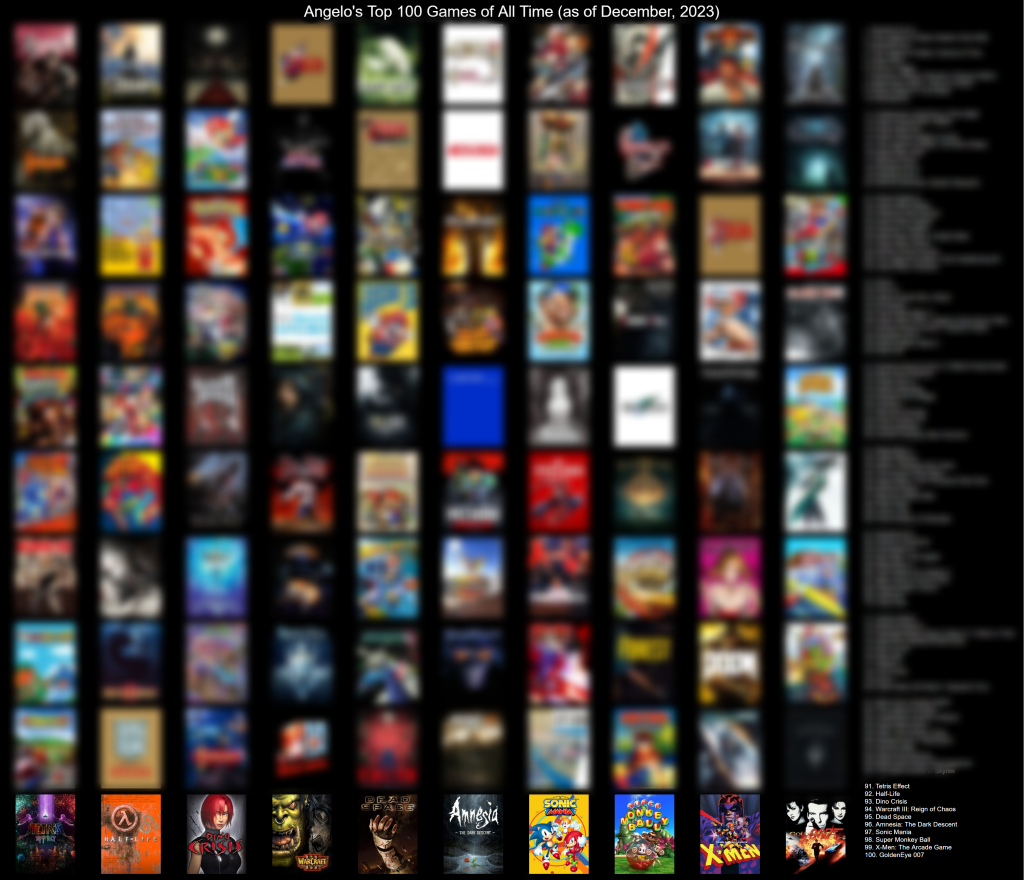
My Top 100 Games of All-Time (So Far)
Next Time!
Two of the most memed upon games in history! One of the most terrifying indie games I’ve ever played! Another game so scary that I wasn’t able to finish it the first time I tried to play through it! Not one, but two different kart racers (and only one has Mario in it)!
It’s games 90-81!

 The Cult Classic
Leave a comment